
Religious & Spiritual
Futarasan-jinja

Nikko sits where the Shogun buried his legacy in gold leaf and lacquer, where cedar trunks planted in 1625 line a road still walked today, and where volcanic water plunges 97 metres into a gorge before pooling in a lake that freezes solid each winter.
Nikko deserves 3–4 days according to Lamaglide's analysis of 29 verified places with measured visit durations. Top sights include Yunoko, Kanmangafuchi Abyss, and Mount Nantai.
How to plan it
Nikko is best visited as a day trip from Tokyo — about 120 min by train. Most travellers sleep in Tokyo.
Plan Tokyo + NikkoYou walk up the stone steps past the vermilion torii of —a bridge rebuilt in 1636 and repainted every few decades in the same ox-blood red—and the forest closes overhead. By the time you reach the Yōmei Gate at , you've climbed 200 metres through cedar shade and crossed into another century. The gate is a rectangle of gold, white and turquoise carved into dragons, peonies, Chinese sages, each panel so dense you stop counting details after fifty. Above the side entrance, a cat sleeps in painted wood; pilgrims have touched its paws smooth over four hundred years.
Across the clearing, 's black-lacquered doors and guardian statues feel quieter—this is the grandson's mausoleum, built in 1653 and designed to defer to Ieyasu's nearby tomb. But the stone lanterns here number in the hundreds, moss-furred and leaning, and in October the maples behind them turn a red that rivals the lacquer. , the oldest of the three, keeps a Heian-era garden where koi circle under a wooden bridge and you can buy hand-copied sutra scrolls at the temple shop for ¥500.
By 4pm the tour groups have boarded their buses and you have the gravel paths nearly to yourself. The light slants gold through the cryptomeria, the only sound the scrape of a rake in the gravel and the distant thunk of a taiko drum from a shrine rehearsal.

Rebuilt in its current form in 1636 using traditional joinery—no nails—and repainted in vermilion lacquer every few decades. The bridge was historically reserved for the shogun and imperial messengers; commoners crossed via a separate wooden span 50 metres downstream. Today you can walk across for ¥300, though most visitors photograph it from the free viewing platform on the west bank.

Constructed over two years (1636–1637) by 15,000 craftsmen, using techniques imported from Ming China and adapted to Japanese carpentry. The Yōmei Gate alone contains over 500 carvings, including a pair of dragons whose scales are painted in alternating gold and white. The famous sleeping cat above the east corridor is only 20cm long—easy to miss if you don't look up. In 1999 the complex was inscribed as a UNESCO site along with Futarasan and Rin'nōji.
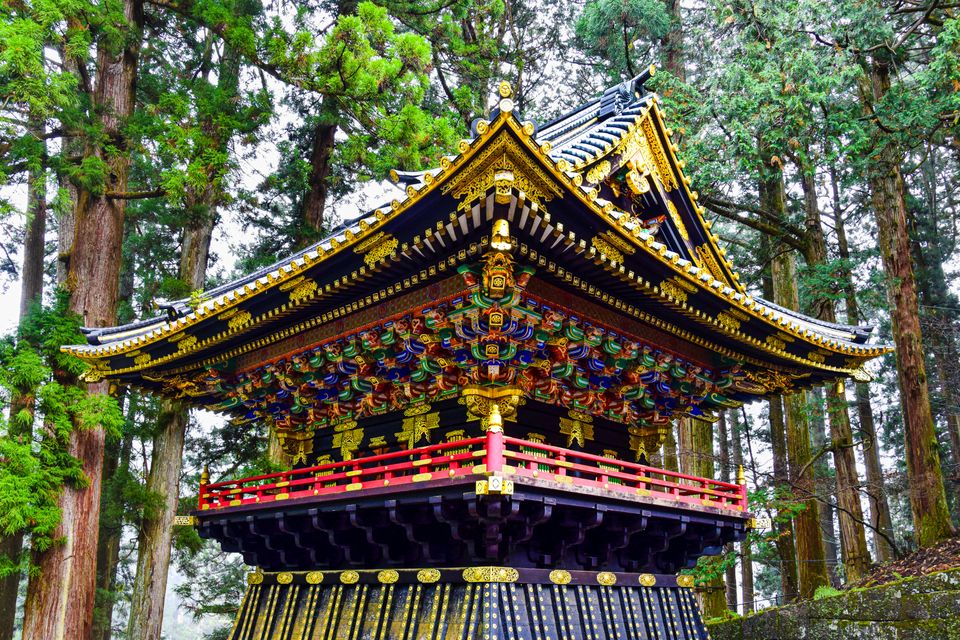
The mausoleum of Tokugawa Iemitsu, third shogun, who ordered it built to face Tōshō-gū so he could honour his grandfather in death. The architectural style deliberately uses darker lacquer and smaller gates to show deference—this is called 'honji suijaku' restraint. The four guardian Nio statues at the entrance gates are carved from single blocks of cypress and stand over three metres tall. In spring, the path up is lined with weeping cherry; in autumn, the encircling maples turn deep crimson.
Founded in the 8th century by the monk Shōdō, who also established Futarasan and opened the pilgrimage route up to Chūzenji. The main hall houses three gilded Buddha statues—each eight metres tall—representing the three sacred mountains: Nantai, Nyohō and Tarō. The Shōyō-en garden behind the temple was laid out in the Edo period and centres on a pond shaped like the character for 'heart'. From April to June, azaleas bloom along the pond edge in pink, white and magenta.
Ten minutes west of the temple precinct, the path narrows to a boardwalk above the Daiya River, where lava cliffs lean out over black water. This is the , a volcanic gorge carved by an eruption of fifteen hundred years ago. The cliffs are smooth basalt, cooled in vertical columns, and along the near bank stand seventy stone jizo—round-bellied monk figures in red bibs, each one slightly different in posture and expression.
Local belief says you cannot count them twice and reach the same number; every recount finds a jizo missing or added. In practice, the trail is soft dirt, the statues are dappled by leaf shadow, and by the time you've walked the line once you've lost your tally anyway. In early November, the maples along the gorge flare orange against the black stone, and you'll meet perhaps three other walkers in an hour. The path continues another kilometre upstream to a small shrine where you can buy a hand-carved jizo for ¥800, or just sit on the bench and watch the river run silent over the rocks.
The gorge was carved by a pyroclastic flow from Mount Nantai around 1,500 years ago; the basalt columns you see are the cooled interior of that flow, exposed by centuries of river erosion. The jizo statues were placed over several centuries by pilgrims and grieving families—each one represents a soul, often a child who died young. Local superstition says the statues move at night, which is why your count always changes; in practice, the shifting light and overlapping shadows make it genuinely hard to track them all.

The volcano last erupted around 7,000 years ago, though fumaroles still vent near the summit and the mountain is classified as active. The climbing season runs May to October; outside those months the trail is officially closed due to snow and avalanche risk. The ascent starts at Futarasan shrine on the north shore of Chūzenji, where you pay a ¥1,000 trail fee and receive a wooden talisman. The summit—marked by a small shrine and stone markers—offers views across the entire Oku-Nikko plateau, weather permitting.
The bus winds twenty minutes uphill from Nikko town through a forest of beech and birch, the road tracing the old pilgrimage route opened in 782 by the monk Shōdō. At the top, spreads flat and grey between forested slopes—four kilometres across, frozen solid from January to March, and edged in summer with rental rowboats and a single gravel beach. The water is cold even in August; the lake exists because lava from Nantai dammed the valley, and its depth reaches 163 metres in the centre.
At the east shore, drops 97 metres in a single white column, visible from a free platform at road level or from a paid elevator that descends into the gorge for ¥570. In late May, when the mountain snow melts, the falls run heavy enough to rattle the viewing deck; by October the flow gentles and you can hear the individual streams that braid down the rockface. A second trail leads south from the lakeshore into , a highland marsh webbed with boardwalks and sightlines that stretch two kilometres across sedge and silver grass to the peaks beyond.
The last bus back down leaves at 5:40pm in low season, 6:20pm in summer. If you miss it, there are three guesthouses along the lakeshore—traditional inns with tatami and lake views—but rooms book out a month ahead during autumn colour.
The lake was formed around 20,000 years ago when lava from Mount Nantai dammed the valley, and it remains one of Japan's highest large lakes at 1,269 metres elevation. The monk Shōdō Shōnin is credited with 'discovering' it in 782, though indigenous Ainu populations certainly knew of it earlier. In the Meiji era, foreign diplomats built summer villas along the south shore to escape Tokyo's heat—some of these Western-style wooden houses still stand and operate as guesthouses.

The falls drop 97 metres from the outflow of Lake Chūzenji, and the volume varies dramatically by season—heaviest in late May during snowmelt, gentlest in midwinter when much of the water freezes into ice columns. The paid elevator (¥570) descends 100 metres inside the cliff to a platform that puts you level with the base of the falls; you feel the spray on your face and hear nothing but the roar. Twelve smaller streams—called the 'Twelve Falls'—braid down the rockface on either side of the main column.

This highland plateau sits at 1,400 metres and was once the bed of an ancient lake that drained when the Yukawa River cut through the lava dam. Today it's a protected wetland—part of Nikko National Park—covering roughly 400 hectares and crossed by four kilometres of wooden boardwalk. The name means 'battlefield plain', supposedly because the wind-rippled sedge grasses resemble armies in motion. From the boardwalk you see Mount Nantai to the northeast, the Oku-Shirane range to the northwest, and in September the grass turns gold and the entire marsh glows at sunset.
The bus winds twenty minutes uphill from Nikko town through a forest of beech and birch, the road tracing the old pilgrimage route opened in 782 by the monk Shōdō.
Another twelve kilometres west, the road ends at , where —a kidney-shaped lake 1,475 metres above sea level—steams faintly at its edges from underwater hot springs. The water is milky turquoise from dissolved minerals, the shore rimmed with white mineral crust, and a three-kilometre trail circles the lake through alpine forest. In June, azaleas bloom pink on the south bank; in October, the maples here turn a week earlier than down at Chūzenji, and you can watch the colour line descend the valley day by day.
The onsen village itself is a single street of six ryokan and a public bathhouse, Yumoto Onsen, where ¥800 buys you access to milky-white indoor pools and an open-air bath that looks straight up at the forest. The water is 42°C, faintly sulphurous, and the changing room keeps a laminated card explaining in English why you must rinse before entering. In winter the village is buried under two metres of snow, the lake frozen, and the road up from Chūzenji impassable without chains.
.jpg?width=960)
The onsen village sits at the western edge of Oku-Nikko, where the road ends and the mountains rise in a wall. The hot springs here have been used since the Edo period, and the water—rich in sulphur and iron—surfaces at around 50°C before being cooled for bathing. The public bath, Yumoto Onsen, was renovated in 2011 and has separate men's and women's sections, each with indoor pools and one rotenburo (open-air bath) looking up at the forested slopes. In winter, snow piles a metre high around the outdoor pool and you soak in steaming water while flakes fall on your head.

Fed by hot springs bubbling up from the lake bed, Yunoko's water stays a few degrees warmer than a normal alpine lake—still cold, but not glacial. The milky turquoise colour comes from suspended minerals, mainly calcium and magnesium sulphate. The three-kilometre shoreline trail is mostly flat, surfaced in compacted dirt and tree roots, and takes about an hour at an easy pace. In June the near shore is edged with blooming azaleas; in October the maples and birches turn scarlet and gold, and the colour reflects in the milky water in surreal gradients.
Average temperatures, crowds and recommended windows — at a glance, month by month.
Climate normals 1991–2020, Japan Meteorological Agency
Cherry blossoms arrive late—usually mid-April at the temples, early May up at Chūzenji—and azaleas follow in June, painting the Yunoko shore pink. The crowds are lighter than autumn, but the lake road sometimes closes until late April due to lingering snow.
The plateau is ten degrees cooler than Tokyo, and the forest shade at Kanmangafuchi feels like air conditioning. Hydrangeas bloom along the temple paths in late June, and in August you can rent a rowboat on Chūzenji and drift under the cliffs. Afternoon thunderstorms are brief and dramatic.
Peak colour hits Yunoko in mid-October, Chūzenji a week later, and the lower temples by early November. The maples at Taiyū-in turn so red they look lacquered, and every viewpoint fills with tripods. Book accommodation two months ahead or accept sold-out signs.
Snow closes the Chūzenji road from December to mid-April, and Yunoko becomes inaccessible. The temple precinct stays open, though, and the Yōmei Gate looks spectacular under fresh snow with almost no tourists. Bring crampons—the stone steps ice over.
Nikko's signature is yuba—the skin that forms on simmering soy milk, lifted in sheets and eaten fresh or fried. You'll find it layered in bento, wrapped around vegetables, deep-fried as tempura, or sold still-warm from a counter. The town also inherited a taste for Western-style comfort food from its 19th-century role as a diplomatic mountain retreat.
Sheets of fresh yuba, served chilled with soy and wasabi; silky, faintly sweet, and gone in three bites. Fujiya lets you watch the sheets being lifted from the vats in the back room.
A skillet of thick noodles, cabbage and pork with a tangle of pickles and miso soup. Hippari-Dako serves it on a hot plate still sizzling, and the portion is enough for two.
A tasting procession of yuba: sashimi, grilled, fried, in broth, in salad. Often ten courses. It's ceremonial, expensive, and the best way to understand what a single ingredient can do.
Meiji-no-Yakata, a stone mansion from 1899, serves Western-style dishes in high-ceilinged rooms with chandeliers. The hamburg is dense, salty, unapologetically retro, and you eat it on the terrace under the maples.
Slurping soba and hot broth is expected; it cools the noodles and signals enjoyment. When offered oshibori (hot towels) before a meal, use them only for hands—not face or neck.
Our engine builds your days hour by hour, based on your actual dates.
Build my trip →The breakdown by category below — each range still depends on your choices.
3 nights: €180–540 (2 pers.)
4 days (2 pers.): €240–480
4 days (2 pers.): €80–160
4 days (2 pers.): €160–320
A combined pass for Tōshō-gū, Taiyū-in and Rin'nōji costs around €25 and saves queuing three times—buy it at the first entry gate you reach.
The final bus back to Nikko town leaves Chūzenji at 5:40pm off-season, 6:20pm in summer; miss it and you're hunting for a lakeside guesthouse or calling a taxi (€60+).
The Chūzenji–Yumoto road closes completely from early December to mid-April due to snow; check current status at the Nikko tourist office before heading up.
Most shrines, small restaurants and local buses accept cash only; bring ¥10,000+ in small notes—there's one 7-Eleven ATM in central Nikko that takes foreign cards.
Autumn colour brings peak crowds; every guesthouse and ryokan within 30km books out by August. If you're visiting mid-October, reserve rooms three months ahead or stay in Utsunomiya and day-trip.
Wild macaques sometimes appear on the trail—don't feed them, don't make eye contact, and keep walking. They're habituated to humans and generally uninterested, but staring provokes them.
Two days covers the temple precinct, Kanmangafuchi, and a half-day at Chūzenji, but you'll skip Yumoto, Senjōgahara and any deeper trails. Three to four days lets you visit the highland lakes, soak in an onsen, and avoid rushing the temples.
Yes—trains take two to two-and-a-half hours each way, leaving time for the temples and Shinkyō bridge. But you'll miss Chūzenji entirely (another 40 minutes by bus each way) and feel the pressure of the last train home around 6pm. Staying one or two nights is worth it.
Peak colour at Chūzenji and the temples usually falls in the last two weeks of October and first week of November, but timing shifts by a week either side depending on the year. Yunoko turns a week earlier. Check real-time reports on the Nikko city tourism site from late September onward.
The standard JR Pass covers the JR Nikko Line, but not the faster Tobu Railway—most travellers use the Tobu Limited Express (€40 return from Asakusa). If you're already holding a JR Pass and have time, the slower JR route via Utsunomiya is free, though it adds 30–40 minutes.
The town centre and temple precinct are entirely walkable—about 20 minutes from the station to Tōshō-gū on flat or gently rising ground. But reaching Chūzenji, Yumoto or Kanmangafuchi requires buses (Chūzenji) or a 30-minute walk along a road with no pavement (Kanmangafuchi). Local buses run frequently and accept IC cards.
Curated places, an itinerary optimized around your dates — endlessly editable.