_-_2023-04-25_-_1.jpg?width=960)
Entertainment
Théâtre de la Maestranza

Seville smells of orange blossom in March and wet stone after the 6 p.m. hose-down of café terraces. The Giralda's 35 ramps wind upward without a single step—designed for the muezzin to ride his horse—and the city still stops work at 2 p.m. in summer, when the metal chairs on Plaza del Salvador become too hot to touch.
Seville deserves 2 days according to Lamaglide's analysis of 182 verified places with measured visit durations. Top sights include Catedral de Sevilla, Olmo, and Torre del Oro.
The opens at 11 a.m. most days, but arrive by 10:45 and you'll climb ahead of the tour groups that clog the first turning. Thirty-five ramps replace stairs—the twelfth-century engineers built them wide enough for the muezzin to ride a horse to the bell chamber. Your calves won't thank you, but your knees will. At the top, 70 meters up, the bronze weathervane—El Giraldillo—spins on its axis, and the rooftops of Santa Cruz spread in a jigsaw of terracotta and whitewash.
Below, the swallows an entire city block, the largest Gothic footprint on earth. Inside, Christophe Columbus rests in a catafalque hoisted by four bronze kings, though historians still argue whether the bones are his or his son's. The choir stalls are carved walnut, each misericord a tiny gothic joke—a monk dozing, a devil yanking a sinner's beard. Spend twenty minutes in the Sala Capitular staring at Murillo's Immaculate Conception; the Virgin's robe folds are so precise you can count the pleats.
Two blocks west, the fills a Renaissance cube that once traded silks. Today it holds 80 million pages documenting the Spanish Empire—maps of Potosí, manifests of galleons lost off Havana, a letter from Cervantes begging for a colonial post. Entry is free; the reading room smells of old vellum and floor wax.

The weathervane at the summit—a bronze female figure holding palm and shield—weighs 1,288 kilograms but spins in a moderate breeze. The ramps inside rise in a steady spiral; on quiet mornings you can hear your own footsteps echo off the brick vaults built in 1198. Every fifteenth ramp has a small arched window looking over a different slice of the city.

Construction began in 1401 on the ruins of the Almohad mosque; the chapter famously declared, "Let us build a church so beautiful and so grand that those who see it will think we are mad." The central nave soars 42 meters, supported by columns so thick three people linking hands can't encircle them. The main altarpiece—carved and gilded over eighty years—contains more than a thousand biblical figures.

Architect Juan de Herrera designed the building in 1584 as the Lonja de Mercaderes, a merchant exchange meant to stop traders doing business on the cathedral steps. The archives moved here in 1785 under Charles III, consolidating documents from Simancas, Cádiz, and Seville. Rotating exhibitions on the ground floor have included original charts by Juan de la Cosa and the papal bull dividing the New World between Spain and Portugal.
was the Jewish quarter until 1492, and it still refuses the grid. Calle Vida and Calle Muerte fork, then dead-end into pocket plazas barely wider than a cart. Jacaranda branches meet overhead on Callejón del Agua, and in late April the fallen blossoms turn the cobbles purple. Geraniums cascade from wrought-iron window grilles that families polish every Sunday; the best displays cluster around Plaza de Doña Elvira, where a broken fountain trickles all afternoon.
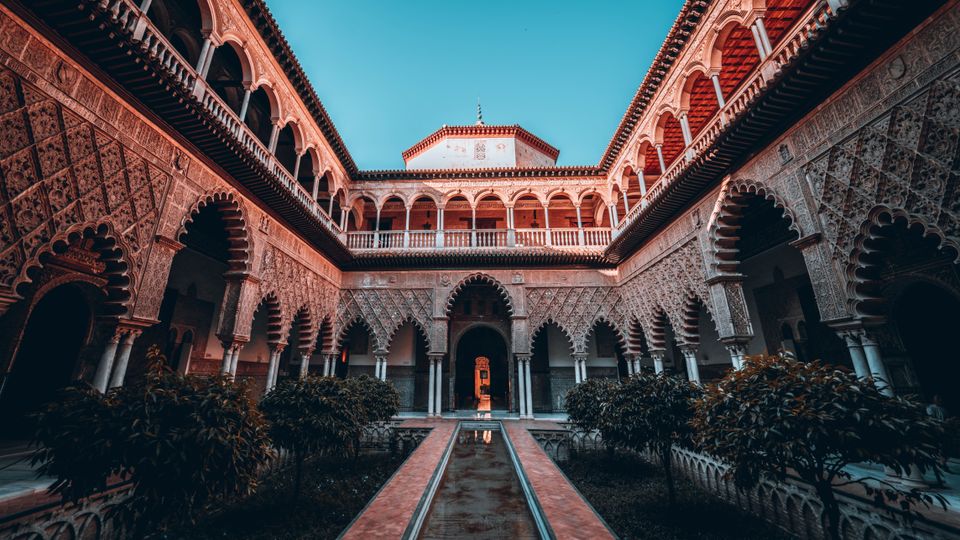
The 's ticket line snakes along the palace wall by 10 a.m., but book online two days ahead and you walk straight through the Puerta del León. Inside, the reflects Moorish arches in a long rectangular pool; Pedro I commissioned the tilework in 1364, hiring craftsmen from Granada who signed their names in the zellige borders. The gardens unroll for acres—peacocks nest in the orange groves, and the Galería del Grutesco hides behind a hedge trimmed into the shape of a galleon.
Exit through the Patio de Banderas onto Plaza del Triunfo and the city exhales. Street musicians park under the monument, a Baroque column raised after the 1755 Lisbon earthquake. Locals ignore it; they're queuing at the gelateria for carrot-cake ice cream or the mandarin sorbet that tastes like the trees that line every Sevillian avenue.

Street names preserve medieval memory: Calle Susona commemorates a Jewish woman who betrayed a conspiracy; Callejón del Agua ran beside an aqueduct feeding the Alcázar. Many houses still have their original sixteenth-century tiles and hand-painted ceramic house numbers. In summer, neighbors rig canvas awnings across entire alleys to create continuous shade from noon to 7 p.m.
The gardens were replanted in stages—some orange groves date to the Almohad period, others to the Renaissance additions under Charles V. The Galería del Grutesco is lined with faux-stalactite grottoes imitating Italian Mannerist style; water channels originally fed by the Caños de Carmona aqueduct still run along the perimeter paths. Peacocks were introduced in the nineteenth century and have nested here ever since, their cries echoing off the palace walls at dawn.

The small cobbled plaza that serves as the Real Alcázar's exit, framed by orange trees and ochre façades. It offers the cleanest view of the Giralda rising over the rooftops—Seville's postcard shot.
Owner and gelato-maker Antonello sources ingredients from local markets—Huelva strawberries in spring, almonds from the Alpujarras, goat cheese from a farm outside Carmona. The texture is denser than industrial ice cream because he churns at a lower speed; flavors rotate weekly but carrot cake, Sicilian pistachio, and mandarin sorbet are near-permanent. The shop occupies a former tile workshop, and the original brick oven is still visible behind the counter.
The squats on the east bank like a twelve-sided honeypot. Its name comes from the golden tiles that clad it in the thirteenth century—most have crumbled, but at sunset the ochre stone glows the same. The small naval museum inside displays astrolabes and a model of the Santa María; climb to the battlements and you can see all the way to the Puente de Isabel II, the iron truss bridge locals call Puente de Triana.
Cross that bridge and you're in the potters' quarter. Ceramica Santa Ana has been throwing clay on Calle San Jorge since 1870; their showroom is a wall-to-wall mosaic of azulejo samples—geometric stars, floral borders, street-name plaques custom-made for Sevillian doorways. Up the block, runs along the river, a parade of bars with plastic chairs scraping the pavement every evening. It's too touristy for serious eating, but perfect for a caña and a view of the Maestranza bullring's whitewashed curve across the water.
For flamenco that isn't dinner-show schmaltz, locals point you to . The tablao seats forty, the guitarist sits close enough to see his fingernails split the strings, and the bailaora's zapateado on the wooden stage sounds like a snare-drum roll. Shows start at 8 p.m. and 10 p.m.; the later set draws the neighborhood aficionados who clap the compás and shout jaleos between verses.

Built in 1220 by the Almohad governor to anchor a chain across the Guadalquivir and block enemy ships, the tower originally had a twin on the Triana bank—long demolished. The golden tiles that gave it its name were likely glazed ceramics reflecting sunlight, though some chronicles claim they were actual gold leaf. The small naval museum inside focuses on Seville's role as departure point for the Indies fleets; the third floor holds a collection of navigational instruments and a relief map of the river's shifting course.

The street was a muddy fishermen's lane until the nineteenth century, when the riverfront was paved and the bars moved in. Buildings lean at odd angles—many rest on wooden piles sunk into the clay riverbank, and subsidence has tilted doorframes over the decades. The name comes from the Roman Baetis, the old name for the Guadalquivir. During the Feria de Abril, the entire street becomes an unofficial fairground extension, with makeshift casetas and dancing until 5 a.m.

The venue opened in 2012 in a restored neighborhood building, designed as a performance space rather than a converted bar. The stage is barely raised, so the front row sits at eye level with the dancers' footwork. Guitarist Paco Lira and cantaor El Pele have both performed here on guest nights; the house troupe rotates but always includes at least one Triana-born bailaor. The wooden floor is replaced every two years because the zapateado wears it down to splinters.
The Torre del Oro squats on the east bank like a twelve-sided honeypot.
The was built for the 1929 Ibero-American Exposition, and it still looks like a film set—which it was, for Star Wars and Lawrence of Arabia. The semicircular plaza stretches 200 meters across, ringed by a canal where you can rent a blue-and-white rowboat for four euros per half-hour. Along the curved arcade, fifty alcoves represent Spain's provinces, each one tiled with scenes of local history: Zaragoza's Siege, Valencia's Tribunal de las Aguas, Salamanca's university scholars in their caps and gowns.
Behind the plaza, the sprawls in a tangle of palmetto and magnolia. Ponds appear without warning—the Estanque de los Lotos blooms pink in June, and bronze frogs spit water at the edges. Peacocks strut along the Glorieta de Bécquer, ignoring the joggers and the old men reading ABC on shaded benches. The park was a private estate until 1893; the Duchess donated it to the city, and Seville turned it into the greenest lung in Andalusia.
Leave via the south gate and you're five minutes from the , housed in a convent where nuns once made candied orange peel. The collection leans heavily on Sevillian Baroque—Zurbarán's white-robed Carthusians, Murillo's street urchins eating melon, Valdés Leal's Vanitas paintings crawling with worms and memento-mori. Entry is free for EU citizens; everyone else pays €1.50.
_-_01.jpg?width=960)
Architect Aníbal González designed the plaza in a neoMudéjar style, mixing Baroque and Moorish Revival elements. The ceramic provincial alcoves were made by the Mensaque Rodríguez factory in Triana; each one required weeks of hand-painting. The central fountain has four jets representing Spain's main rivers—Ebro, Duero, Guadalquivir, Tajo. The plaza has stood in for Cairo, Baghdad, and Naboo in films; location scouts love the symmetry and the light off the canal.

The park's layout was designed by French landscape architect Jean-Claude Nicolas Forestier for the 1929 Exposition. He imported species from across the Mediterranean—date palms from North Africa, jacarandas from Argentina, magnolias from the Americas. The Monte Gurugú is an artificial hill built from Exposition rubble, offering a modest viewpoint over the treetops. On weekends, Sevillian families claim the shaded benches for hours-long picnics of tortilla and ensaladilla.

The building was the Convento de la Merced Calzada until the 1835 confiscation of church properties; the cloister's ceramic fountain and original tiles remain intact. Room V holds Murillo's vast Immaculate Conception painted for the Franciscans, restored in 2016 to reveal blues and golds that had darkened under centuries of candle soot. The Zurbarán gallery (Room X) displays his monk portraits—faces so lifelike you can see individual whiskers and the weave of their habits.
Average temperatures, crowds and recommended windows — at a glance, month by month.
Normales climatiques 1991–2020, AEMET (Agencia Estatal de Meteorología)
Orange blossom perfumes the air in late March, the Alcázar gardens explode in wisteria and jasmine, and Semana Santa processions fill the streets with incense, drums, and hooded penitents carrying century-old pasos until 3 a.m.—then the Feria de Abril takes over with a week of flamenco dresses, rebujito, and casetas lit like paper lanterns.
Temperatures hit 40°C by mid-July and the city empties—locals flee to the coast, shops close from 2 p.m. to 6 p.m., and only tourists brave the cathedral queue at noon. But evenings come alive: rooftop bars open, the Guadalquivir promenade fills with cyclists and ice-cream vendors, and you can eat dinner outside at 10:30 p.m. under a sky still streaked with purple.
September heat lingers but loses its edge, October brings warm days and cool nights perfect for wandering Santa Cruz without sweating through your shirt, and by November the first rains scrub the dust off the cobbles—the city smells of wet stone, roasting chestnuts, and the first batch of pestiños fried for the approaching Christmas season.
Seville's winter is mild—15°C most afternoons, bright sun, occasionally a cold morning that locals treat like the Arctic. Terraces stay open, museums are blissfully empty, and you can book the Alcázar without a two-week lead time. Christmas lights strung along Calle Sierpes stay up through January, and bars serve thick hot chocolate with churros all day long.
Seville eats late—kitchens open for lunch at 1:30 p.m. and don't take dinner orders before 9 p.m. Tapas culture means you'll rarely sit for a full meal; instead, you stand at zinc bars, order three or four plates, then move to the next place. The best streets for bar-hopping are around Plaza Alfalfa and Calle Mateos Gago, but avoid anywhere with a photo menu or a tout at the door.
Spinach and chickpea stew slow-cooked with cumin, garlic, and a pinch of pimentón—served lukewarm in a clay dish, the way it's been made since the bar opened in the 1930s. The flamenquines (breaded pork rolls) are equally legendary, fried to order and still too hot to bite for the first two minutes.
Two scoops from OLMO—the carrot cake tastes like spiced cream-cheese frosting with tiny walnut chunks, the pistachio is almost savory with a faint salt edge. The texture is dense, artisanal, and melts slower than factory ice cream. Perfect after walking the Alcázar gardens in afternoon heat.
Avocado toast elevated: sourdough from the in-house bakery, smashed Hass avocado with lime and chili flakes, topped with a slow-poached egg and microgreens. The café serves brunch all day—come at 11 a.m. for strong flat whites and a table on the sunny terrace. Popular with local freelancers and international students.
A cheese board showcasing five or six southern varieties—Payoyo from Cádiz, Torta del Casar oozing from its rind, manchego aged eighteen months. Paired with quince paste, Marcona almonds, and a glass of oloroso. The dining room is narrow, the wine bottles double as décor, and it's tucked just far enough from the cathedral to dodge the tour-group tide.
At standing tapas bars, locals don't order everything at once—they'll have a caña and a tapa, chat for ten minutes, then order another round. Tossing your napkin or toothpick on the floor is still standard practice in old-school bars; it's not rude, it's tradition. And don't ask for the bill until you're truly ready to leave—rushing through tapas marks you as a foreigner faster than any phrase-book Spanish.
Our engine builds your days hour by hour, based on your actual dates.
Build my trip →The breakdown by category below — each range still depends on your choices.
2 nights: 100–400 € total for the stay
2 people × 2 days: 200–480 € for all meals
Seville's historic center is entirely walkable; main cost is airport transfer
Budget 50–100 € total for 2 people over 2 days, depending on how many paid sites you visit
Book online at least 48–72 hours in advance, especially March–May and October–November. Walk-up tickets vanish by 10 a.m. in high season, and queues can stretch an hour. The official website is the only reliable source; third-party resellers often add €5–10 markup.
Shops, small museums, and even some restaurants close from 2 p.m. to 5 or 6 p.m., especially in summer. Supermarkets and chain stores stay open, but if you need a pharmacy, hardware store, or local boutique, plan for morning or late afternoon. Major monuments (cathedral, Alcázar) keep continuous hours.
Many old-school bars (El Rinconcillo, Casa Ricardo) don't take cards, or they do reluctantly with a minimum spend. Carry €20–30 in small bills; ATMs cluster around Plaza Nueva and Calle Sierpes. High-end restaurants and hotels accept cards without issue.
The cathedral offers free entry for locals on Mondays (sometimes extended to all visitors—check ahead), and the Museo de Bellas Artes is free for EU citizens year-round. Archivo de Indias is always free but has limited exhibits unless there's a temporary show.
Tourist tablaos along Calle Mateos Gago often pair mediocre performances with overpriced set menus. Locals recommend Teatro Flamenco Triana, La Casa del Flamenco, or Casa de la Memoria—intimate venues where the artists are professionals, not performers hired for the season. Expect to pay €18–30 for a quality 60–75 minute show.
Seville plants bitter Seville oranges (naranjas amargas) as street trees—used for marmalade, not fresh eating. Picking the fruit is technically illegal and they taste terrible raw. The blossoms in March and April, however, are what make the whole city smell like a perfume shop.
Two days is enough to see the main monuments (cathedral, Giralda, Alcázar, Plaza de España), wander Santa Cruz, catch a flamenco show, and eat very well. You won't have time for day trips (Itálica, Carmona) or deep museum dives, but you'll leave with a solid feel for the city. If you have a third day, add the Museo de Bellas Artes or a slow afternoon in Parque de María Luisa.
Yes, Seville is very safe after dark, especially in the historic center. Streets around Santa Cruz, Arenal, Plaza Nueva, and the cathedral stay lively until past midnight with locals and tourists. Pickpocketing is the main risk (not violent crime)—keep your phone and wallet secure in crowds. Solo travelers, including women, report feeling comfortable walking around late; just avoid poorly lit side streets near the train station or the outskirts of Triana after 11 p.m.
Completely. The historic center is compact—you can walk from the cathedral to Plaza de España in twenty minutes, and most major sights lie within a 1.5 km radius. Cobblestones make it tough on wheeled luggage and strollers, and August heat can be punishing at midday, but otherwise walking is the best (and often only practical) way to get around. Taxis and buses are available for longer hops or airport transfers.
Not essential, but helpful. Major tourist sites, hotels, and restaurants in the center have English-speaking staff. Tapas bars, neighborhood shops, and anyone over 50 may speak little to no English—learning basic phrases (por favor, gracias, la cuenta, ¿cuánto cuesta?) goes a long way and earns you smiles. Menus in traditional bars are often Spanish-only; snap a photo and use Google Translate, or just point and ask for the house specialty.
March to May and October to November. Spring brings orange blossoms, perfect temperatures (18–24°C), Semana Santa processions, and the Feria de Abril—but also peak crowds and higher prices. Autumn offers warm days, fewer tourists, and golden light for photography. Summer (June–August) is scorching (often 38–42°C) and locals desert the city; winter is mild and quiet, ideal for budget travelers who don't mind the occasional grey day.
Curated places, an itinerary optimized around your dates — endlessly editable.


