
Spring (April–May)
BestCherry blossoms frame every temple gate, the Sanno Matsuri festival in mid-April pulls out the gilt floats and puppet shows, and morning-market greens—fiddlehead ferns, bamboo shoots—taste of snowmelt and new growth.

Takayama wears its Edo past on every corner: latticed merchant houses, sake breweries pressing since the 1690s, and morning markets where octogenarian farmers sell mountain vegetables under canvas exactly as their grandmothers did. Tucked into the Japan Alps at 573 meters, this former castle town preserves the carpentry, the festivals, and the marbled Hida beef that made it indispensable to the shoguns—and still feels like a secret the bullet train hasn't spoiled.
Takayama deserves 1–2 days according to Lamaglide's analysis of 44 verified places with measured visit durations. Top sights include Takayama Matsuri Yatai Kaikan, Takayama Jinya, and Sanmachi Suji.
By 7:10 a.m., the vendors at are already laying out pickled daikon, chrysanthemum buds, and trays of mitarashi dango. The market stretches along the east bank of the Miyagawa River, a single file of blue tarp stalls manned mostly by women over sixty who've been growing these turnips and shiso leaves on the same plots since the 1980s. Across the red-lacquered Bridge, the wooden facades of are still in shadow, their slatted windows and black-tile roofs sharp against the morning sky.
Walk south into the old merchant quarter and the sake perfume hits before you see the sugidama—giant cedar balls hung outside every brewery to signal the new pressing. At , five hundred yen buys you ten thimbles of sake ranging from bone-dry junmai to a cloudy nigori that tastes of fermented rice and stone-fruit. The tasting counter is a slab of hinoki cypress polished by two decades of elbows; by 9 a.m. it's elbow-to-elbow with day-trippers, but arrive at opening and you'll have the brewer to yourself.
.jpg?width=960)
The market runs every morning from around 7 a.m. to noon along a four-hundred-meter stretch of the Miyagawa River's eastern bank. Most vendors are older women who've farmed the same mountain plots for decades; their daughters help set up but rarely take over—this generation may be the last. In April you'll find wild sansai (mountain vegetables) and cherry-blossom mochi; by October, it's chestnuts, apples, and new-harvest rice.
Originally built in the Edo period and reconstructed several times, Nakabashi's current incarnation dates from the 1960s but keeps the traditional vermilion lacquer and arched wooden railings. The bridge connects the station side of town to Sanmachi Suji and offers the classic postcard view: latticed merchant houses reflected in the Miyagawa, backed by the Japan Alps. In cherry-blossom season, pink petals drift downstream and catch in the bridge pilings.
.jpg?width=960)
Sanmachi Suji refers to three parallel streets—Ichinomachi, Ninomachi, Sannomachi—lined with two-story wooden machiya (merchant houses) that date mostly from the late Edo and Meiji periods. Many still function as family businesses: sake breweries, miso shops, pickle vendors, and craft galleries occupying the same plots their founders claimed in the 1700s. The streetscape is protected by municipal ordinance—no neon, no vending machines, no modern facades—so the effect is unusually coherent.

Harada Brewery (often called Hida Sake Brewery by travelers) has been pressing sake in Takayama since the Meiji era. The tasting room occupies the front of the old kura storehouse; for five hundred yen you receive a wooden paddle with ten small cups, each filled with a different expression—junmai, ginjo, nigori, and seasonal specials. The staff will explain the rice-polishing ratios and fermentation temperatures if you ask, but they're equally happy to let you taste in silence.
is the only surviving provincial headquarters of the Tokugawa shogunate outside Tokyo. Built in 1615 and restored in the 1990s, the complex sprawls across tatami-floored reception halls, a tile-roofed courthouse where tax disputes were adjudicated, and a rice granary whose beams still bear the carpenters' ink marks from 1691. The garden—raked gravel, pruned pines, a single stone lantern—feels less like decoration than a lesson in restraint.
Guides lead ninety-minute tours in Japanese, but the English audio app walks you through the magistrate's chambers and the interrogation room, whose wooden floor planks are worn concave by three centuries of kneeling defendants. In April the weeping cherry in the courtyard blooms the color of faded silk; in October the ginkgo drops a carpet of gold coins onto the gravel. Either way, arrive before 10 a.m. to avoid the tour buses that stack up by late morning.

For 177 years—from 1692 to 1969—Takayama Jinya served as the administrative seat of the Hida region, first under the Tokugawa shogunate, then the Meiji government. The current buildings are a mix of original 17th-century timbers and faithful 1996 reconstructions; the tatami, sliding doors, and even the iron-nail joinery follow Edo carpentry techniques. Walk barefoot through the magistrate's quarters, the tax-rice storeroom, and the interrogation chamber, and you're tracing the daily geometry of shogunate power.
Twenty minutes west by bus, the gathers more than thirty farmhouses transplanted from remote valleys when hydroelectric dams flooded their original sites in the 1960s and '70s. The gassho-zukuri structures—named for their steep thatched roofs that resemble praying hands—were built without nails, using interlocking beams of Japanese zelkova and rafters lashed with wisteria vine. Inside, the smoke from irori hearths has stained the ceiling timbers black as lacquer over two hundred years.
Volunteers in indigo work-wear demonstrate straw-rope braiding and wood-turning on pole lathes; in the largest house, a loom the size of a dining table still weaves strips of asa linen. The site feels less like a museum than a working archive—every beam labeled with its original village, every roof re-thatched by the same guild of craftsmen who maintain the UNESCO sites in Shirakawa-go. Budget two hours to walk the hillside circuit; the view from the upper pond, with the Alps behind the thatched eaves, is the postcard Takayama doesn't need to exaggerate.
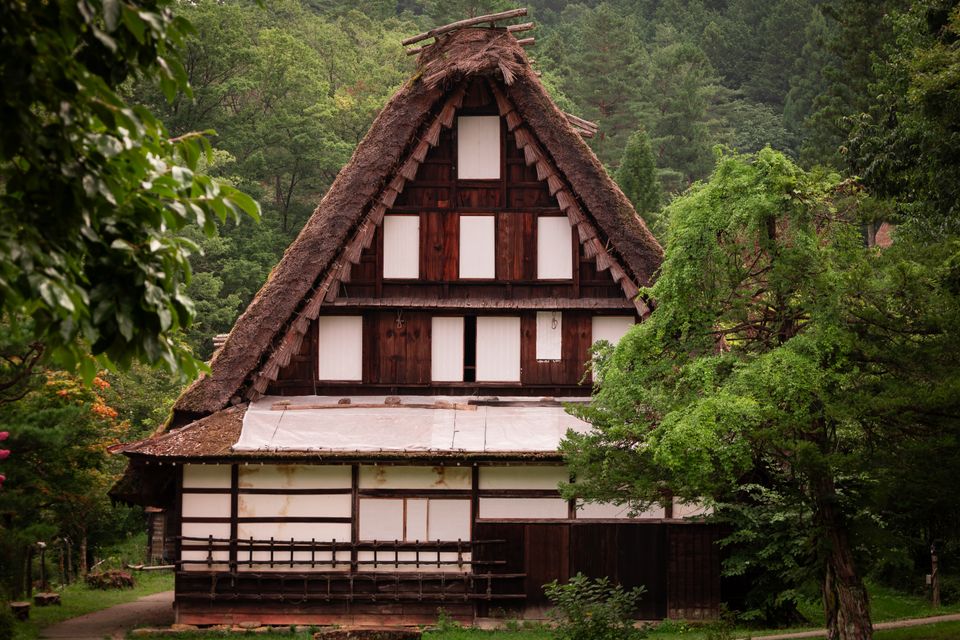
Hida no Sato assembles more than thirty traditional buildings—farmhouses, storehouses, a village shrine—transplanted from remote valleys across Gifu Prefecture when dam projects flooded their original sites in the 1960s and '70s. The curators labeled every beam with its provenance, so you can trace a roof rafter back to a specific mountain hamlet. In winter, volunteers light the irori hearths to keep the thatch dry; the smoke stains the ceiling and perfumes your coat with woodsmoke for hours afterward.
Twenty minutes west by bus, the Hida no Sato Folk Village gathers more than thirty farmhouses transplanted from remote valleys when hydroelectric dams flooded their original sites in the 1960s and '70s.
The houses four of the twenty-three festival floats that parade through town twice a year—spring and autumn—each one a three-story marvel of gilt lacquer, mechanical puppets, and carvings so intricate they took master craftsmen a decade apiece. The floats rotate every four months, so you'll never see the same lineup twice. Stand close and you can make out the individual scales on a carved dragon, the fingernails on a wooden courtesan.
By noon, hunger pulls you back to Sanmachi Suji. At , a narrow counter wedged into a merchant house, the sushi nigiri are topped not with fish but with slivers of A5 Hida beef, barely seared, that melt on warm rice. Three pieces cost around eight euros and constitute the most efficient luxury in town. If you want ceremony, seats you at an iron teppan grill inside a converted sake brewery—you cook your own cuts, thin as paper, on a surface hot enough to caramelize in five seconds. Either way, the marbling tells the story: Hida cattle graze on mountain grasses and sake lees, and the fat tastes faintly of fermentation and alpine flowers.

The Yatai Kaikan sits beside Sakurayama Hachimangu Shrine and displays four of the eleven floats used in the October Hachiman Matsuri; the selection rotates every four months, so no two visits show the same lineup. Each float—called a yatai—stands three stories tall and took a team of lacquerers, carpenters, and metal-smiths up to a decade to complete. The mechanical karakuri puppets, operated by hidden strings and pulleys, can pour sake, write calligraphy, and perform acrobatic flips; some date from the 18th century and still function perfectly.
Hida Beef Baya is a narrow counter-service shop wedged into a renovated machiya on Sannomachi; there are perhaps six stools and a short queue by 11:30 a.m. The menu is minimal: beef sushi (thin-sliced A5 Hida wagyu on rice), yakitori skewers, and croquettes. The sushi arrives on a wooden paddle, three pieces, barely seared so the fat is translucent. You eat it in three bites, standing or perched on a stool, and walk out having spent eight euros and experienced luxury as a snack.
Aji-no-Yohei occupies a converted sake brewery on the edge of Sanmachi Suji; the dining room keeps the original exposed beams, plaster walls, and cedar pillars. You sit at an iron teppan grill embedded in your table and cook your own Hida beef—sliced thinner than bacon, marbled like a topographic map—on a surface heated to around 200°C. The beef takes five to seven seconds per side; any longer and you've committed a minor tragedy. A set meal (beef, rice, miso soup, pickles) runs about 3,500–4,500 yen per person.
Average temperatures, crowds and recommended windows — at a glance, month by month.
Climate normals 1991–2020, Japan Meteorological Agency
Cherry blossoms frame every temple gate, the Sanno Matsuri festival in mid-April pulls out the gilt floats and puppet shows, and morning-market greens—fiddlehead ferns, bamboo shoots—taste of snowmelt and new growth.
June brings the rainy season—umbrellas, humidity, and empty guesthouses—but by late July the Alps open for hiking and the riverside beer gardens pour cold Hida lager under paper lanterns. August heat can top 32°C; locals retreat indoors by noon.
The Hachiman Matsuri unfolds in early October—more floats, night parades lit by lanterns—and by late October the maples in Shiroyama Park ignite in red and gold. Market stalls pile high with chestnuts, persimmons, and new-crop rice.
Snow dusts the thatched roofs at Hida no Sato by mid-December and doesn't melt until March; mornings at the Jinya-mae market are bitter but beautiful, vendors stamping feet beside braziers. Sake tastes richer in the cold, and the onsen an hour south become non-negotiable.
Takayama's food reputation rests on two pillars: Hida beef—A5-grade wagyu raised in the surrounding mountains—and centuries-old sake breweries that open their tasting rooms to the street. Breakfast means the morning markets; lunch is beef in every conceivable form; dinner, if you time it right, is river fish or house-made soba in a quiet izakaya away from the tourist grain.
Octopus balls griddled to order at a single blue-tarp stall, crisp outside, molten inside, dusted with bonito flakes that dance in the steam. The vendor has worked this pitch for thirty years; her takoyaki are the market's worst-kept secret.
Nigiri topped with A5 wagyu instead of fish—barely torched, so the fat glosses your lips. Three pieces, eaten standing at a wooden counter, redefine the concept of fast food.
You cook your own Hida beef—sliced thinner than prosciutto—on a searing iron plate at your table. The setting is a Meiji-era sake brewery with exposed beams; the beef takes five seconds per side and tastes of mountain grass and umami.
Buckwheat noodles made that morning, served cold on a bamboo mat with a dipping sauce of dashi and wasabi. The texture—firm, slightly nutty—reminds you that soba is a craft, not a commodity.
In sake breweries, finish each tasting cup before moving to the next—pouring dregs back into the bottle is a mortifying breach. At teppan grills, cook your beef one or two slices at a time; piling the plate leads to uneven searing and silent judgment from the chef.
Our engine builds your days hour by hour, based on your actual dates.
Build my trip →The breakdown by category below — each range still depends on your choices.
80–140 € for one night (two people, mid-range)
100–180 € meals for two over one day
Negligible if you stay central; budget 20–40 € for bus or taxi to outlying sites
20–40 € total for key entries and tastings
The Sanno Matsuri (April 14–15) and Hachiman Matsuri (October 9–10) draw tens of thousands; book accommodation six months ahead or resign yourself to staying in Takayama's suburbs or Nagoya.
Both Miyagawa and Jinya-mae markets pack up by 12:00–12:30 p.m.; arrive before 9 a.m. for the full spread and elbow room.
Many small restaurants, market stalls, and sake breweries accept yen only—ATMs at the post office and 7-Eleven near the station are your safest bets.
The folk village is 20 minutes west by Nohi Bus (runs every 30–60 min); last return is around 5 p.m., so check timetables or budget for a taxi back (¥1,500–2,000).
Each brewery charges ¥300–500 for a tasting set; visiting three or four means ¥2,000 and a pleasant buzz—plan accordingly if you're driving or cycling.
Takayama Jinya and Hida no Sato offer English audio guides, but smaller temples and neighborhood restaurants may have Japanese-only signage—Google Translate's camera mode is essential.
One full day covers Sanmachi Suji, the morning markets, Takayama Jinya, and a Hida beef lunch comfortably, with time for sake tasting and a short temple walk. Add a second day if you want to explore Hida no Sato properly, hike the Higashiyama Promenade, or day-trip to Shirakawa-go (90 min by bus). Takayama rewards a slow pace—two days lets you linger without the clock.
Yes, if you want Japan's Edo atmosphere without Kyoto's crowds. Takayama preserves merchant-quarter architecture, working sake breweries, and festival traditions that feel lived-in rather than curated for tourists. It's less monumental than Kyoto but more intimate, and the Hida beef alone justifies the detour. Skip it only if your itinerary is Tokyo–Kyoto express and you have zero flexibility.
Takayama is famous for its twice-yearly festivals (Sanno and Hachiman Matsuri), featuring enormous lacquered floats and mechanical puppets; its Edo-period merchant streets (Sanmachi Suji); Hida beef, a marbled wagyu rival to Kobe; and a cluster of centuries-old sake breweries that still press and sell on-site. It's also the gateway to the Japan Alps and the UNESCO gassho-zukuri villages.
Take the JR Tokaido Shinkansen to Nagoya (100 min), then transfer to the JR Hida Limited Express to Takayama (140 min)—total journey around 4.5 hours, fully covered by the JR Pass. Alternatively, highway buses run direct from Tokyo (Shinjuku) to Takayama in 5.5–6 hours and cost less (¥5,000–7,000) but offer no flexibility or comfort advantage over the train.
Yes, but it's tight. Nohi Buses run from Takayama to Shirakawa-go in 50–90 minutes (depending on route); you can leave Takayama at 9 a.m., spend three hours in Shirakawa-go, and return by 4 p.m., leaving a short evening in Takayama. Better: sleep in Takayama, day-trip to Shirakawa-go, then return for dinner and the morning market the next day. Doing both villages justice in a single rushed day shortchanges both.
Curated places, an itinerary optimized around your dates — endlessly editable.